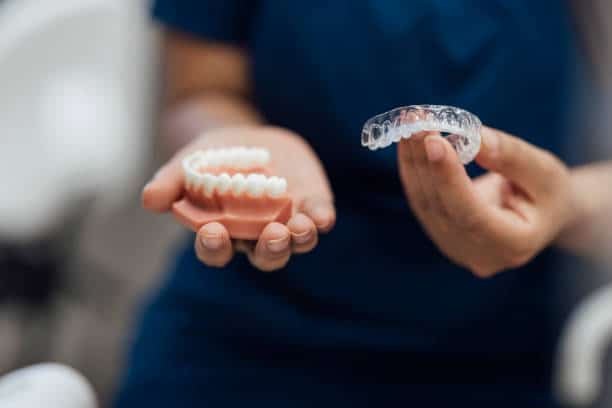
Invisalign moves teeth through controlled orthodontic force paired with the body’s own bone-remodeling process. Teeth are not rigidly fixed into the jaw. Each tooth sits inside a periodontal ligament, a thin band of tissue that connects the tooth root to the surrounding bone. When an aligner applies gentle, sustained pressure, that pressure triggers biological changes in the bone around the tooth. Bone is broken down in small amounts on one side and rebuilt on the other, and the tooth gradually shifts into its new position.
Each Invisalign tray represents one small step in a larger plan. No single tray moves a tooth very far. Instead, a series of clear aligners works together, and professional monitoring in Charlotte, NC helps confirm that teeth are tracking safely toward their final positions throughout treatment.
This article explains the biology behind Invisalign treatment, the biomechanics that allow clear aligners to create controlled tooth movement, how treatment is sequenced, and why professional monitoring matters at every stage.
How Does Invisalign Move Teeth with Controlled Orthodontic Force?
Invisalign aligners are made to be slightly different from a patient’s current tooth positions. Each tray in the series is manufactured to match the next planned step, not the smile as it looks today. When a patient wears the aligner, that small mismatch creates gentle, directional pressure against specific teeth.
This pressure does not move teeth all at once. Invisalign clear aligners apply force gradually, and the aligner sequencing determines which teeth move first, which teeth stay in place to anchor the movement, and which direction each tooth travels. The magnitude and direction of that orthodontic force both matter. Too little force does not produce meaningful tooth alignment, and force applied in the wrong direction can slow progress or create unwanted side effects.
Tooth movement itself happens biologically. The aligner does not pry a tooth into a new spot. It sets up the conditions that allow surrounding bone and tissue to remodel over time, producing controlled tooth movement through a process covered in detail later in this article.
How Do Clear Aligners Apply Pressure to Teeth?
Each Invisalign tray fits closely over the teeth. Because the tray is shaped for a slightly different position than where the teeth currently sit, the aligner material flexes slightly when worn. This elastic deformation is what generates aligner force.
That force is gentle and sustained rather than sharp or sudden. It presses toward the planned position for each tooth, and as one tray finishes its work, the next tray in the sequence introduces a new, slightly adjusted force vector.
It helps to be clear about what this pressure does not do. Controlled pressure does not push a tooth through solid bone the way a nail moves through wood. Instead, gradual tooth movement follows a chain of events: aligner force leads to a biological response in the tissue, that response leads to remodeling, and remodeling allows the tooth to move.
Why Does Each Invisalign Tray Move Teeth Only a Small Amount?
Small, incremental tooth movement is not a limitation of the technology. It reflects how living tissue adapts to mechanical stress.
The periodontal ligament response to pressure takes time. Cells need time to signal, tissue needs time to adapt, and bone needs time to remodel in a coordinated way. If a single tray tried to move a tooth too far, too fast, it would outpace what the periodontal ligament and surrounding bone can safely accommodate, creating unnecessary stress on tissue that is still adjusting to the previous stage.
Keeping each Invisalign treatment stage small improves movement predictability and gives the treatment team better force control while reducing unnecessary stress on the surrounding tissue. Several trays work in sequence to complete what looks, from the outside, like one continuous movement. In practice, that movement is made up of many small, controlled steps, and this aligner progression is what keeps controlled orthodontic movement gentle and manageable for the surrounding tissue.
What Happens Beneath the Gums When Invisalign Moves a Tooth?
Understanding what happens beneath the gums helps explain why Invisalign treatment takes weeks rather than days for each stage of movement. Three biological components work together every time a tooth moves: the periodontal ligament, the alveolar bone, and the specialized cells responsible for bone remodeling.
Here is the general sequence, step by step:
- Aligner force changes the pressure on the periodontal ligament.
- That pressure change triggers cellular signaling in the surrounding tissue.
- On the pressure side, the side of the tooth root facing the direction of movement, bone resorption begins.
- On the tension side, where the ligament stretches, new bone formation begins.
- As this process continues, the tooth moves in the intended direction.
Peer-reviewed research on bone remodeling during orthodontic treatment describes this as a coordinated process, where bone resorption by osteoclasts and new bone formation by osteoblasts occur in response to the specific pattern of pressure and tension created by orthodontic force.
What Role Does the Periodontal Ligament Play in Tooth Movement?
The periodontal ligament is a layer of connective tissue between the tooth root and the surrounding alveolar bone. It is not just a cushion. It supports the tooth during normal biting and chewing, absorbs everyday mechanical force, and contains blood vessels and cells that respond to changes in pressure, relaying that mechanical stress to the surrounding bone and tissue.
When an Invisalign aligner applies orthodontic pressure, the periodontal ligament is the first tissue to register that change. On the compressed side, blood flow and cellular activity shift in ways that eventually signal bone resorption. On the stretched side, the ligament’s fibers help stimulate new bone formation. This biological tooth movement process depends on a healthy, responsive periodontal ligament, which is one reason gum and bone health are evaluated before Invisalign treatment begins.
How Do Osteoclasts Make Space for a Moving Tooth?
Osteoclasts are cells that break down small amounts of bone. During orthodontic tooth movement, they become active on the pressure side of the tooth root, the side facing the direction the tooth is moving.
This bone resorption is a normal, controlled part of orthodontic bone remodeling. It is not the same as bone damage or bone loss from disease. The process removes just enough bone to allow the tooth to shift gradually, and it happens alongside new bone formation on the opposite side, which keeps the tooth properly supported throughout treatment.
How Do Osteoblasts Rebuild Bone Behind the Moving Tooth?
Osteoblasts are the cells responsible for building new bone. As a tooth moves, the periodontal ligament stretches on the tension side, opposite the pressure side where osteoclasts are active. That stretching stimulates osteoblasts to begin new bone formation.
This is what allows a tooth to arrive at its new position with solid support underneath it. Alveolar bone remodeling on the tension side fills in behind the moving tooth, and this bone continues to mature and adapt even after the tooth reaches its target position, maintaining structural support and contributing to long-term tooth stability once treatment is complete.
How Does Invisalign Control Different Types of Tooth Movement?
Straightening a smile is rarely a single kind of movement. Different teeth often need to move in different directions, and Invisalign treatment is planned to account for each one individually.
Orthodontic movement generally falls into a few categories: tipping, where the crown of the tooth angles in one direction while the root stays relatively still; bodily movement, where the crown and root move together; rotation, where a tooth turns around its own axis; and intrusion, extrusion, and root movement, which involve shifting a tooth vertically or adjusting the root’s position within the bone.
How Does Invisalign Rotate Crooked or Twisted Teeth?
Rotated teeth can be more difficult to move than teeth that simply need to shift forward or backward. A tooth with a round cross-section, such as a canine or premolar, gives the aligner less surface area to grip, which makes tooth rotation harder to control with the tray alone.
In these cases, small tooth-colored attachments are sometimes added to the tooth surface to give the aligner more purchase. These auxiliary tools support Invisalign tooth movement without changing the underlying orthodontic biomechanics involved in correcting rotated teeth safely.
How Does Invisalign Move a Tooth Up, Down, or Forward?
Different movement directions require different force systems. Intrusion refers to moving a tooth further into the bone, which is typically used to adjust a tooth that sits slightly lower than its neighbors. Extrusion refers to moving a tooth outward, or further out of the bone, which can help bring a shorter tooth down to match the bite line.
Mesial and distal movement describes shifting a tooth along the dental arch, either toward the front of the mouth or toward the back. This type of movement is often used when closing spaces, and patients curious about how this applies to visible gaps can review this practice’s guide to closing spaces between teeth for a closer look at that specific scenario.
Can Invisalign Move Tooth Roots as Well as Crowns?
Effective orthodontic treatment often requires more than moving the visible part of the tooth. Root movement matters because a tooth that looks straight from the outside can still have a root positioned incorrectly within the bone, which affects long-term stability and periodontal support.
This is the difference between tooth tipping, where mostly the crown shifts, and bodily tooth movement, where the root moves along with it. Achieving accurate orthodontic root control requires careful planning, which is one reason digital treatment planning plays such an important role in modern Invisalign treatment.
How Does Digital Invisalign Planning Determine Where Each Tooth Moves?
Invisalign treatment in Charlotte, NC is not simply a matter of manufacturing a stack of trays and handing them to a patient. Each case is planned as a sequence, with every tooth’s movement staged, directed, and mapped out before the first aligner is ever produced. This planning stage is what turns the biological process described earlier into a specific, individualized set of instructions for each tooth.
This digital orthodontic planning process starts with detailed intraoral scans of the patient’s current teeth and bite, which are used to build a digital tooth model of the entire arch. From there, a treatment plan lays out how each tooth will move, in what direction, in what order, and how those movements interact with one another, including whether attachments will be needed to support certain movements. Every decision in the plan works backward from the final treatment goal, the specific bite and alignment outcome the patient and dentist agree on before treatment begins.
For patients considering an Invisalign provider in Charlotte, NC, this staged planning process is part of what distinguishes a customized approach from a generic one.
What Does a 3D Invisalign Scan Show?
A 3D scan captures a detailed digital model of the mouth, which becomes the foundation for treatment planning and a useful record for tracking progress. A typical Invisalign scan shows:
- Current tooth positions
- Arch form
- Spacing or crowding present
- The bite relationship between the upper and lower teeth
- A baseline record for comparing progress throughout treatment
It is important to note that scanning alone does not diagnose every biological condition. A scan shows tooth positions and structure, but a full evaluation of gum health, bone health, and other factors still requires a clinical exam.
Why Is the Sequence of Tooth Movement Important?
Not every tooth can move at the same time or in the same stage of treatment. Some movements require space to be created first. Other teeth need to stay in place temporarily to serve as anchorage while neighboring teeth shift.
Treatment sequencing accounts for these interactions. Moving teeth in a planned order, rather than all at once, keeps force levels predictable and reduces the chance that one movement interferes with another. Good orthodontic planning depends on this kind of staging, since predictable tooth movement is what allows aligner sequencing to translate a digital plan into safe, effective results.
Why Do Some Invisalign Movements Need Attachments or Elastics?
Aligners alone can move many teeth effectively, but they have limits when it comes to gripping certain tooth shapes or generating force in specific directions. Small attachments and elastics are sometimes added to address these gaps without changing the overall biological process described earlier in this article.
When Do Invisalign Attachments Improve Force Control?
Attachments are most often used to support rotation, extrusion, root movement, and cases involving tooth shapes that are naturally harder for a smooth aligner to grip. They act as additional points of contact, giving the tray more control over how force is applied to a specific tooth.
Why Are Elastics Sometimes Added for Bite Correction?
Elastics connect the upper and lower aligners to generate force between the two arches, rather than just within one arch. This can help address bite relationships such as overbite or underbite tendencies, which ties into how Invisalign treatment can support broader bite alignment and jaw comfort over the course of treatment.
Is Invisalign Tooth Movement Safe for Teeth, Roots, and Bone?
Professionally planned Invisalign treatment relies on controlled forces and the body’s natural capacity for biological adaptation. That said, no orthodontic treatment carries zero risk. Expected pressure and some temporary tooth mobility are a normal part of treatment, while persistent pain, unusual swelling, or signs of more forceful, traumatic movement are not, and those symptoms are worth bringing to your dentist’s attention.
Healthy gums, healthy bone, and good oral hygiene all support a smoother course of treatment. Professional monitoring and appropriate force levels help keep tooth movement within a safe, predictable range throughout the process.
Does Invisalign Loosen Teeth While They Are Moving?
Some mild, temporary mobility during orthodontic treatment is normal. It reflects the fact that the periodontal ligament and surrounding bone are actively remodeling to allow the tooth to shift.
This differs from the kind of mobility caused by periodontal disease, which results from bone and ligament loss rather than planned, temporary adaptation. Teeth typically stabilize again once they reach their intended position and the surrounding bone finishes rebuilding.
Can Invisalign Damage Tooth Roots?
Orthodontic treatment, including treatment with clear aligners, can carry some risk of root resorption, a process where a small amount of root structure is lost during movement. Research on root resorption risk during orthodontic treatment indicates that the degree of resorption depends on several factors, including force levels, the complexity of the movement, individual biology, and how long treatment continues.
In most cases, resorption that does occur is minor and does not affect long-term tooth function. Professional monitoring throughout treatment helps identify any concerning changes early, which is part of why regular check-ins are built into the Invisalign process rather than treated as optional.
Does Invisalign Wear Away Tooth Enamel?
Tooth movement itself does not wear away enamel. The forces involved in shifting a tooth’s position are different from the abrasive or mechanical forces that cause enamel wear, such as grinding or aggressive brushing.
Oral hygiene still matters throughout treatment. Plaque buildup and acidic exposure remain separate risks to enamel health, and aligners can trap food and bacteria against the teeth if they are not cleaned regularly, so consistent hygiene habits stay important during Invisalign treatment just as they would with any orthodontic option.
Why Does Professional Monitoring Matter During Invisalign Tooth Movement?
A treatment plan is a prediction based on how teeth typically respond to force, but biological responses vary from person to person. Professional monitoring by an Invisalign dentist in Charlotte, NC exists to confirm that a patient’s actual tooth movement response matches the plan, and to make adjustments when it does not.
Regular check-ins allow the treatment team to evaluate aligner tracking, how teeth are actually responding to the current stage of force, gum health, and how the bite is developing over the course of treatment. An experienced Invisalign provider in Charlotte, NC uses these visits to catch small issues before they affect the overall outcome of Invisalign treatment in Charlotte.
What Does It Mean When Invisalign Is “Tracking” Correctly?
Tracking refers to how closely a tooth follows its planned path during a given stage of treatment. When Invisalign is tracking correctly, the aligner fits snugly against the teeth, with each tooth positioned close to where that stage’s tray expects it to be.
Signs of poor tracking might include a tray that feels loose in certain areas or gaps between the tray and specific teeth. These situations do not necessarily indicate a problem, but they are worth mentioning at a check-in rather than something a patient needs to diagnose on their own.
Why Might the Original Invisalign Plan Need Refinements?
Because biological responses to orthodontic force vary, not every planned movement finishes exactly on schedule. Some teeth may need slightly more time or a small course correction partway through treatment.
When this happens, a new scan allows the treatment team to generate refinement aligners that complete the remaining movement. Refinements are a normal part of many Invisalign cases, not a sign that something went wrong with the original plan.
How Does Controlled Invisalign Tooth Movement Improve Long-Term Bite Function?
Straightening teeth is not only about how a smile looks. The way teeth come together affects chewing, force distribution, and long-term oral health. Better alignment can also make it easier to clean between teeth and along the gumline, supporting periodontal access and gum health over time.
Occlusion, or how the upper and lower teeth meet, plays a role in how evenly biting forces spread across the mouth. Well-aligned teeth tend to distribute those forces more evenly, which can support healthier long-term wear patterns and make certain restorative treatments more predictable down the road.
How Does Better Alignment Improve How Teeth Contact?
When teeth are properly aligned, they tend to meet more evenly during biting and chewing. This creates a more balanced pattern of occlusal contacts across the dental arch, rather than concentrated pressure on just a few teeth.
It is worth noting that not every bite issue leads to TMJ-related symptoms, and Invisalign treatment is not a guaranteed fix for jaw pain. For patients specifically concerned about that connection, more detail is available in the practice’s article on how Invisalign corrects bite and reduces TMJ symptoms.
Why Can Better Alignment Help Protect Teeth from Uneven Wear?
Teeth that meet unevenly can develop uneven wear patterns over time, since some teeth absorb more force than others during normal biting and chewing. Improving alignment helps distribute that force more evenly across the arch.
The general pattern runs from alignment to contact pattern to force distribution to long-term tooth protection. Better alignment does not eliminate wear, but it can reduce the concentration of force on any single tooth or group of teeth.
FAQs About How Invisalign Moves Teeth
How does Invisalign actually move teeth?
Invisalign moves teeth by applying controlled orthodontic force through a series of custom aligners. That force stimulates a response in the periodontal ligament, which triggers bone remodeling in the surrounding alveolar bone. As bone is resorbed on one side and rebuilt on the other, the tooth shifts gradually into its planned position, with each aligner completing one small step of the overall sequence.
Does Invisalign move the tooth or just the visible crown?
Invisalign is designed to move the entire tooth, not just the visible crown. Achieving a stable result often requires controlling root position as well, since a tooth with a well-positioned crown but a poorly positioned root can still create long-term issues. Digital treatment planning accounts for this by mapping root movement alongside crown movement, and attachments can help improve root control in more complex cases.
How fast do teeth move with Invisalign?
Teeth move gradually with Invisalign, using small, incremental movements built into each stage of treatment. The overall speed of treatment depends on individual biological response and the complexity of the movements involved, since rotations, extrusions, and root movements generally take more time than simple tipping. Consistent aligner wear also plays a role in keeping treatment on schedule.
Can Invisalign move teeth through bone?
This is a bit of a misleading way to describe the process. Teeth do not move through solid bone. Instead, the bone itself remodels around the moving tooth, with osteoclasts resorbing bone on the pressure side and osteoblasts forming new bone on the tension side. The alveolar bone adapts to orthodontic force throughout treatment, rather than acting as a fixed barrier the tooth pushes past.
Why do Invisalign trays feel tight at first?
A new aligner often feels tight when first worn because it applies active orthodontic pressure toward the next planned tooth position. This pressure causes temporary tightness that typically eases within a few days as the tooth begins to move and the gap between the aligner and the tooth narrows. This adjustment period is a normal part of wearing each new tray in the sequence.
Learn How Invisalign Can Straighten Your Teeth in Charlotte, NC
Understanding the biology behind Invisalign can make the process feel less like a mystery and more like a plan you can trust. At Smile Moore Dental, an Invisalign consultation starts with a close look at your tooth position, bite, gum health, and treatment goals before any plan is proposed.
Digital scans and personalized treatment planning allow your Invisalign dentist in Charlotte to map out exactly how your teeth need to move and in what sequence. If you are exploring clear aligners in Charlotte and want a clear, evidence-based explanation of what to expect, scheduling a consultation is the best next step toward finding out whether Invisalign in Charlotte, NC is the right fit for your smile.
